
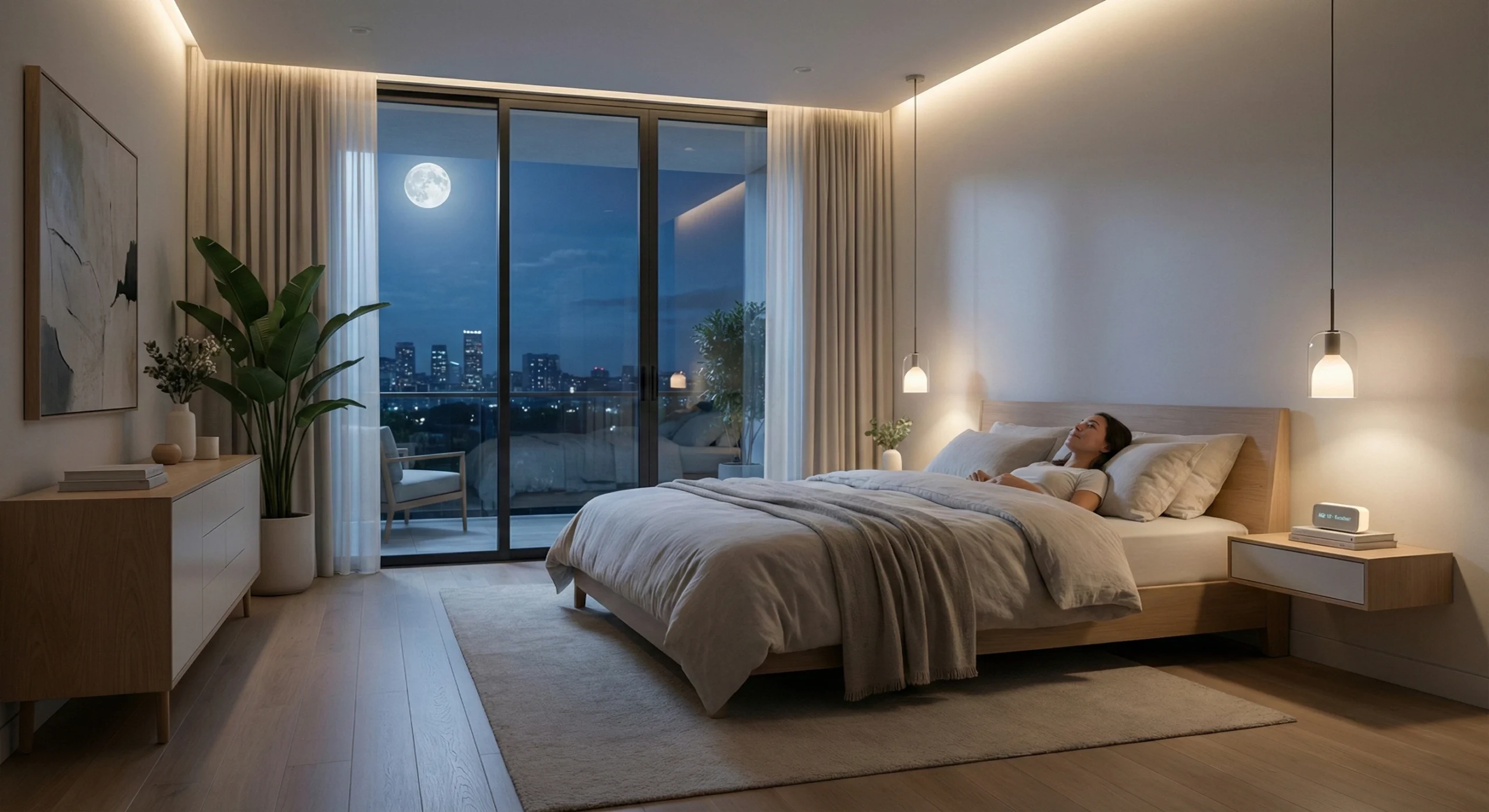
Many people notice that breathing feels different once they lie down at night. The room looks clean, the temperature feels normal, yet the air suddenly seems dense, stale, or harder to breathe. This sensation rarely comes from a single cause. Instead, it reflects a series of small changes in bedroom air quality that develop quietly over several hours.
As doors and windows remain closed, carbon dioxide slowly builds up, ventilation weakens, humidity rises, and fine particles return to the breathing zone. None of these changes feel dramatic on their own, but together they can make the air feel heavier and gradually reduce sleep quality.
Understanding why this happens is the first step toward restoring lighter, cleaner air and more restorative sleep.
What Does “Heavy Air” in a Bedroom Really Mean?
When people describe bedroom air as heavy, stuffy, or stale, they usually react to how the air feels, not to an obvious odor or visible problem. The sensation reflects the body’s response to subtle shifts in air composition that occur overnight.
During the day, movement, open doors, and natural airflow refresh indoor air constantly. At night, this cycle stops. Windows stay closed, doors remain shut, and the same volume of air stays trapped for hours.
Several quiet processes begin to overlap:
- Carbon dioxide rises with every breath
- Furniture and textiles retain heat and moisture
- Settled dust and allergens return to the air
Each change seems minor. Together, they make the air feel denser and less fresh, even if chemical pollution remains low.
The brain becomes more sensitive to these shifts at night. As breathing slows during sleep, small differences in air quality feel stronger than they do during the day. Heavy air rarely signals danger. It usually shows that the room did not refresh itself enough before sleep.
In the following sections, we will look at how gas balance changes, why ventilation matters so much, how humidity and dust intensify this feeling, and how simple habits can break this cycle.
How Oxygen and Carbon Dioxide Levels Change at Night
The most basic reason for heavy air at night is the slow rise of carbon dioxide in closed rooms.
Even during sleep, the body keeps breathing. Each inhale uses oxygen. Each exhale releases carbon dioxide. During the day, fresh air balances this exchange. At night, in a closed bedroom, the balance happens inside a nearly sealed system.
In small or poorly ventilated rooms, carbon dioxide can rise from about 400 ppm outdoors to 800–1200 ppm overnight. These levels are not dangerous, but many people feel:
- A stronger urge to take deep breaths
- A sense of stale or thick air
- Mild headache or morning fatigue
The brain regulates breathing mainly according to carbon dioxide, not oxygen. Even when oxygen remains sufficient, rising CO₂ creates the feeling of breathing difficulty.
This effect becomes stronger when:
- The room is small
- Windows and doors stay fully closed
- Two people sleep in the same room
- No air movement occurs overnight
Breathing also becomes slower and more shallow during sleep. This reduces how quickly the lungs remove carbon dioxide. The brain often responds with brief micro-awakenings that fragment deep sleep without leaving a memory.
In most bedrooms, oxygen never falls to dangerous levels. The real problem is carbon dioxide accumulation and reduced air freshness. This explains why opening a window in the morning brings immediate relief.
This gas imbalance becomes especially problematic when ventilation is insufficient, which leads us to the next key factor.
The Role of Poor Ventilation in Nighttime Air Quality
Poor ventilation forms the structural foundation of heavy bedroom air.
Many homes air out rooms during the day, but at night ventilation often stops completely. Doors close, windows remain shut, and the bedroom becomes a closed container for hours.
Ventilation does more than bring in oxygen. Its main role is to remove used indoor air and replace it with fresh air. When this process stops, the air slowly degrades.
Over the night:
- Carbon dioxide accumulates faster
- Gases from furniture and cleaning products remain
- Moisture stays trapped in textiles
- Dust and particles linger in the breathing zone
Modern buildings worsen this effect. High insulation improves energy efficiency but greatly reduces natural air leakage. Older homes allowed small, constant air exchange. Newer homes often allow almost none.
Sleeping with the door fully closed further limits air volume. Even a small door gap allows slow air exchange and noticeably improves breathing comfort.
Poor ventilation rarely produces smell or visible dirt. Yet the air quietly loses quality, creating the base for the heavy air sensation.
In the next section, we will look at another factor that often works together with poor ventilation: humidity and how it changes the way air is perceived.
How Humidity Makes Bedroom Air Feel Heavier
Humidity strongly shapes how air feels, even when people do not consciously notice it.
During the night, humidity rises naturally. Breathing releases water vapor. Light sweating adds moisture. Reduced airflow prevents dispersion. Cooler air holds moisture more easily. Over hours, relative humidity slowly increases.
As humidity rises, air begins to feel:
- Denser and heavier
- Less cooling
- Thicker during breathing
Moist air reduces heat exchange and evaporation in the lungs. Breathing requires slightly more effort, even without clear awareness.
For most people:
- 35–50% humidity feels most comfortable
- Above 50%, air feels heavy
- Above 65%, many feel stuffy and restless
Humidity also encourages dust mites, keeps mold spores airborne longer, and increases moisture retention in bedding. Warm and humid rooms feel far more oppressive than cool and dry ones.
A common mistake is running a humidifier all night. Without ventilation, this often pushes humidity too high and worsens heavy air.
This leads directly to another invisible factor: how dust and allergens build up overnight.
How Dust and Allergens Accumulate Overnight
Dust and allergens quietly add weight to nighttime air.
During the day, particles settle on surfaces and move with airflow. At night, bedding, carpets, and curtains become major particle reservoirs. Skin cells, pollen, and fine dust collect in textiles.
When you lie down, pull the blanket, or change position, these particles re-enter the breathing zone.
The air may contain:
- Fine dust
- Dust mite proteins
- Mold spores
- Pollen residues
These particles rarely cause disease, but they strongly affect the perception of air cleanliness. Without airflow, the same particle-rich air stays in the room for hours.
This often explains morning symptoms such as:
- Nasal congestion
- Dry throat
- Mild cough
- Burning eyes
These effects reflect particle exposure overnight, not illness.
These are usually not signs of illness, but simple effects of particle-rich air inhaled overnight. This invisible load directly reduces sleep quality.
Why Heavy Air Makes You Sleep Worse
Heavy air does more than feel uncomfortable. It quietly disrupts sleep physiology.
Rising carbon dioxide and particle load stimulate the breathing center. The brain makes small breathing adjustments that trigger micro-awakenings. These shorten deep sleep and disturb REM cycles.
Heavy air also increases the workload of breathing muscles. Moist and particle-rich air reduces gas exchange efficiency. The autonomic nervous system compensates all night, lowering sleep efficiency.
This effect becomes stronger in:
- People with nasal congestion
- Light snorers
- Allergy sufferers
- Those with narrow airways
- Young children
Humidity and poor air quality also disturb thermal comfort, increasing night sweating and position changes.
Individually, these effects seem mild. Together, they explain why many people say:
- “I slept long but don’t feel rested.”
- “I kept turning all night.”
- “I wake up with a heavy head.”
Heavy air rarely causes acute illness, but over time it systematically lowers sleep quality and indirectly affects immunity, metabolism, and mood.
This is why simple nighttime habits and small environmental improvements can make a measurable difference in how well you sleep.
Simple Ways to Improve Bedroom Air at Night
Improving heavy air rarely requires complex systems.
The most effective step is ventilating 15–20 minutes before bedtime. This removes accumulated carbon dioxide and moisture quickly. The goal is not to keep windows open all night, but to start sleep with fresh air.
Short, intensive ventilation works better than leaving small gaps for hours.
Leaving the door slightly open allows slow air exchange from other rooms and reduces overnight carbon dioxide buildup.
Manage humidity carefully:
- Keep humidity between 40–50%
- Run humidifiers in a controlled way
- Avoid wet towels and open water overnight
Reduce dust load:
- Vacuum weekly
- Wash bedding regularly
- Air pillows and duvets
- Minimize carpets and heavy curtains
Air purifiers can reduce particles and allergens, but they do not replace ventilation.
A simpler, less crowded bedroom naturally stays fresher through the night.
Finally, room layout plays a role. Overcrowded rooms with many textiles trap moisture and particles more easily. A simpler, more open bedroom naturally stays fresher through the night.
When Heavy Bedroom Air Becomes a Health Concern
Heavy air alone does not indicate disease. But persistent symptoms deserve attention.
Seek further evaluation when there is:
- Frequent nighttime breathing difficulty
- Repeated waking with air hunger
- Severe morning headaches
- Strong daytime fatigue
- Loud snoring with breathing pauses
These patterns may suggest sleep-related breathing disorders.
Chronic moisture and mold also matter. Persistent damp odor, visible mold, and constantly high humidity create long-term airway stress.
People with allergies often feel stronger nighttime symptoms from pollen, dust mites, and animal hair.
If heavy air appears only on certain nights and improves with simple measures, it usually reflects environmental comfort.
If it persists, worsens, and combines with other symptoms, a broader evaluation helps.
The purpose of this article is not to define heavy air as a medical condition, but to show that healthy sleep depends strongly on healthy air.
Short Summary and Practical Takeaways
Heavy bedroom air usually results from combined factors:
- Carbon dioxide buildup
- Insufficient ventilation
- Rising humidity
- Dust redistribution
This combination makes air feel denser and harder to breathe, even without chemical danger.
Sleep quality declines. Deep sleep shortens. Micro-awakenings increase. Morning freshness fades.
The most effective steps:
- Ventilate briefly before bedtime
- Avoid sleeping with the door fully closed
- Keep humidity at 40–50%
- Reduce dust-trapping surfaces
- Clean bedding regularly
In most cases, these simple adjustments noticeably improve nighttime air and lead to better, more restorative sleep.
